


SEO, AEO & GEO
SEO, AEO & GEO
Grow your visibility in search engines and AI-driven search environments. ClickEdge helps with technical SEO, content structure, AEO, GEO and an approach that brings search behaviour, authority and findability together.
SEO, AEO & GEO
Findability is changing. The fundamentals aren't.
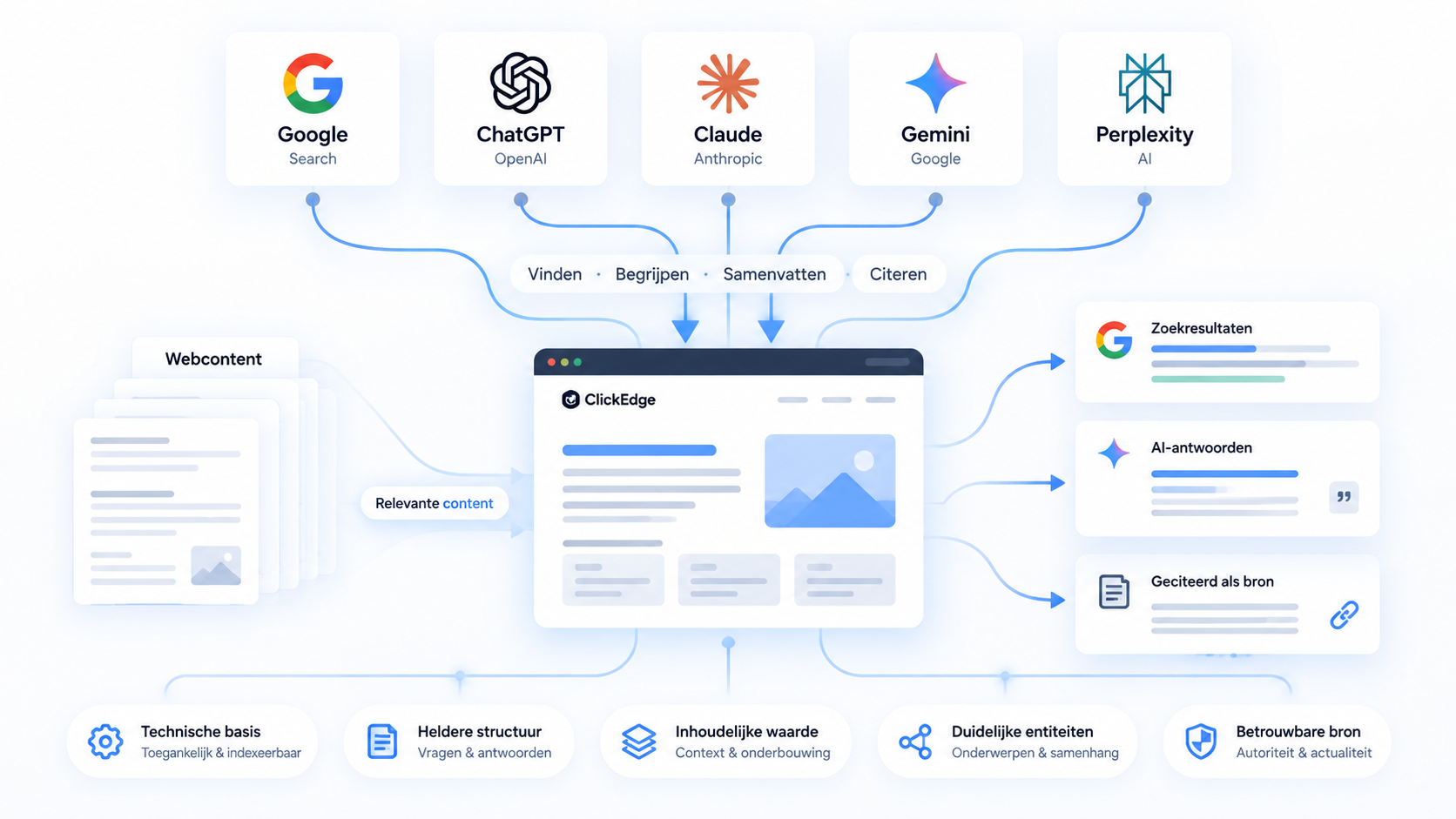
Search has long stopped being just about ten blue links. People still search on Google, but increasingly get direct answers, AI summaries and generative results. On top of that, platforms such as ChatGPT, Gemini, Claude and Perplexity are increasingly used to find information, suppliers and solutions.
That changes how organisations need to look at online visibility. Technical SEO, relevant content and authority remain important. At the same time, it's becoming more important that information is clearly structured, well substantiated and genuinely usable for systems that generate answers rather than just showing search results.
ClickEdge brings those elements together: not choosing between SEO or AI visibility, but understanding how both reinforce each other.
SEO
What is SEO?
SEO stands for Search Engine Optimization. The goal is to make a website as strong as possible technically, editorially and structurally for relevant search queries in search engines. Good SEO isn't just about keywords. It includes, among other things:
- technical accessibility
- crawlability and indexation
- search intent
- content quality
- internal linking
- website structure
- authority
- speed and user experience
- clear entities and topics
SEO helps search engines understand what a website is about, which queries content is relevant for, and which pages hold enough value to become visible. That makes SEO the foundation that other forms of organic visibility build on.
AEO
What is AEO?
AEO stands for Answer Engine Optimization. AEO focuses on answering concrete questions as clearly as possible. That requires content that's logically structured, gives a direct answer and contains enough context to be interpreted correctly. AEO can be relevant for, among other things:
- featured answers
- AI Overviews
- voice search
- question-based search
- AI assistants
- answer engines
The core idea isn't to write text artificially for AI, but to structure information clearly enough that both people and machines quickly understand what the answer is. Clear content works better for visitors and for systems trying to compile answers.
GEO
What is GEO?
GEO stands for Generative Engine Optimization and focuses on visibility within generative search and AI environments. Different factors come into play there than traditional rankings alone. Generative systems try to understand, combine and contextualise information. Source quality, substantiation, entities, recency, context and citability can all play a role.
GEO is therefore less about a single position in a search result and more about the question: is your content substantively strong, clear and trustworthy enough to be included in a generative answer?
GEO increases the quality and usability of content for generative search environments, without suggesting guarantees that no one can give.
Differences
SEO, AEO and GEO in one overview
SEO
- Primary goal
- Being found
- Focused on
- Search engines
- What matters
- Technology, content, search intent, authority
- Typical outcome
- Visibility in organic search results
- Examples
- Google Search, Bing
AEO
- Primary goal
- Giving a direct answer
- Focused on
- Answer engines and AI answers
- What matters
- Structure, clarity, question-answer format, semantics
- Typical outcome
- Direct answer, snippet or AI summary
- Examples
- AI Overviews and answer engines
GEO
- Primary goal
- Being mentioned or cited in AI answers
- Focused on
- Generative search engines and LLM-driven environments
- What matters
- Context, entities, source value, substantiation, citability
- Typical outcome
- Mention, source use or substantive inclusion in generative answers
- Examples
- ChatGPT, Gemini, Claude, Perplexity and other generative systems
SEO makes sure you can be found. AEO makes sure your information is immediately usable as an answer. GEO focuses on how well generative systems can understand, assess and potentially use your content as a source.
The three overlap heavily. Good GEO usually doesn't start with GEO alone. Without technical accessibility, relevant content and clear structure, AI also lacks a solid foundation.
Why it's connected
SEO, AEO and GEO aren't separate worlds
A technically weak website doesn't suddenly become strong because a GEO strategy is added on top. A page without clear structure doesn't automatically become usable for answer engines, and content without substantive value doesn't suddenly become a trustworthy source because schema markup has been added. The foundation stays the same: good content needs to be accessible, relevant, clear and trustworthy.
SEO drives technical and organic findability. AEO helps structure information better as an answer. GEO focuses on how usable that information is within generative systems. The best approach connects those elements.
LLMs & search
What are LLMs and why are they relevant to search behaviour?
LLM stands for Large Language Model. These are models that process huge amounts of language and information to recognise patterns and generate new answers. Well-known applications include ChatGPT, Claude and Gemini.
Where a classic search engine mainly tries to find and rank relevant documents and pages, an LLM can combine information from different sources and contexts into a single answer. That has consequences for online visibility. It becomes more important that content:
- is substantively clear
- contains sufficient context
- is well substantiated
- uses clear entities
- aligns with concrete questions
- is trustworthy and up to date
- is logically connected to other relevant content
LLMs don't change the need for good SEO. They actually increase the importance of strong, structured and trustworthy content.
What ClickEdge does
From technical foundation to AI visibility
Technical SEO
Checking crawlability, indexation, technical errors, internal structure, canonicals, sitemap, performance and other factors that can limit organic visibility.
Content & Search Intent
Analysis of search queries, content structure and substantive relevance. Not writing for keywords alone, but for the question a visitor is actually trying to solve.
AEO
Structuring content around clear questions, answers, definitions and context so information can be interpreted faster and more accurately.
GEO
Strengthening content on source value, context, entities, substantiation and citability for generative search environments.
Structured Data
Applying structured data where it's substantively and technically relevant, without using schema markup as a trick or a guarantee.
Measurement & Reporting
Tracking organic performance via, among others, Search Console, GA4 and additional analysis. Where possible, classic search data is combined with new insights into AI visibility.
SEO, AEO and GEO are part of a broader approach. Explore the other services or read how ClickEdge works if you want to outsource Online Marketing.
Technical SEO & measurement
Visibility starts with understanding what Google and users actually see
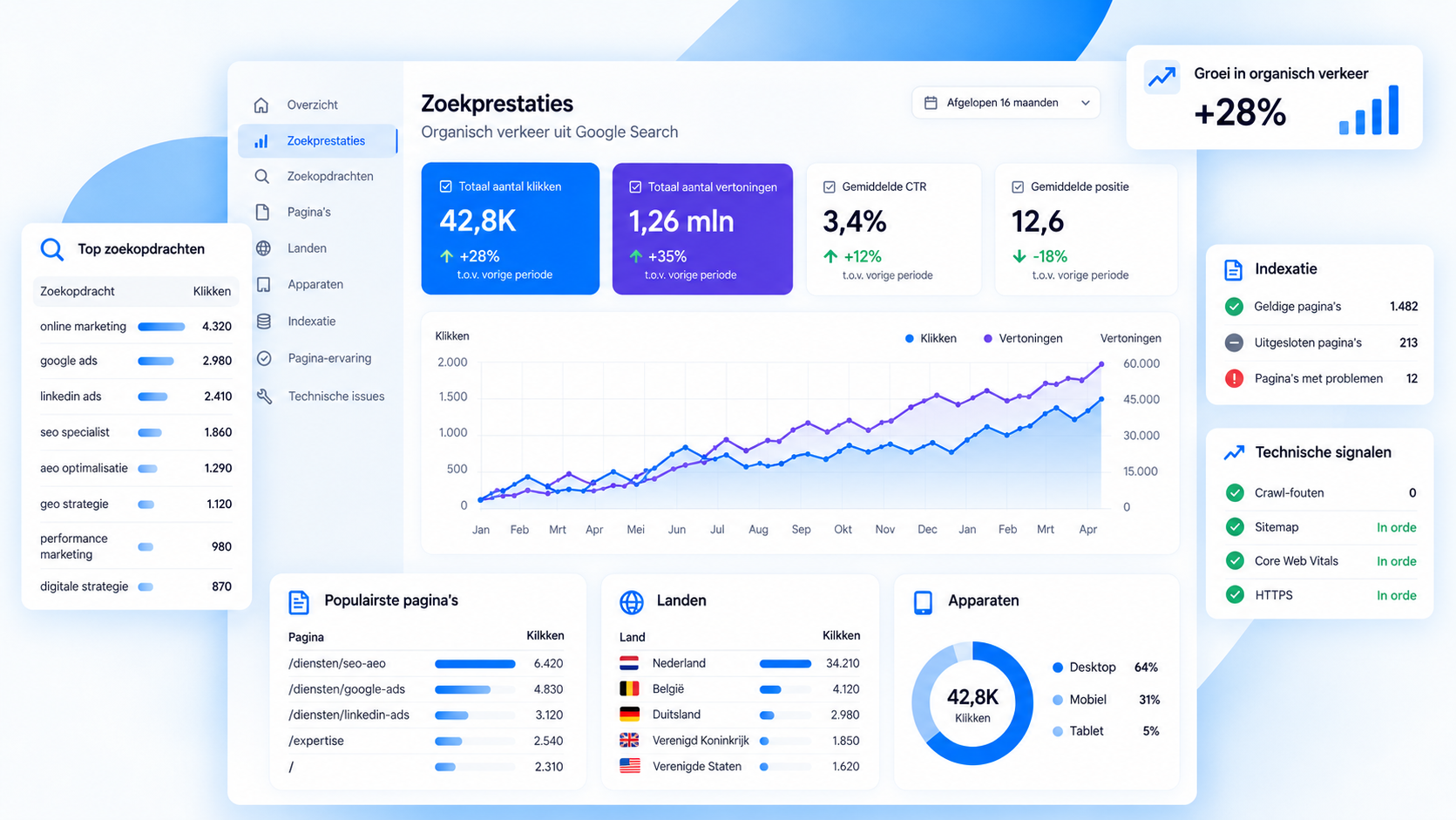
SEO remains measurable. Search Console shows which queries a website is visible for, which pages attract traffic, how clicks and impressions develop and where technical or indexation issues arise. That data helps determine where optimisation is genuinely needed.
With AEO and GEO, measurement is less straightforward: not every AI mention is as measurable as a click from Google. That's why ClickEdge looks at multiple signals and avoids false precision.
Approach
No SEO checklist, working from impact instead
- 01
Analysis
Technology, content, search intent, structure and existing organic performance are assessed.
- 02
Prioritisation
Not every SEO issue has the same impact. We first determine where the biggest opportunities or blockers lie.
- 03
Optimisation
Technology, content, internal linking, AEO structure and GEO elements are improved in a targeted way.
- 04
Measuring & adjusting
Results are tracked and new search developments are factored into the next round of optimisations.
Who it's for
For organisations that want to look at organic visibility beyond rankings alone
- B2B
- SaaS and technology
- E-commerce
- SMEs
- International organisations
- Websites with a lot of knowledge content
- Organisations that want stronger visibility in both classic and AI-driven search
The exact approach depends on market, website, existing content, competition and commercial objectives.
No hype
AI is changing search. Not every SEO rule is changing with it.
New terminology makes it easy to repackage old principles, but ClickEdge doesn't do that. Technical quality, relevant content, authority, clear structure and good user information remain essential.
AEO and GEO add new points of attention, but they don't replace SEO. The focus is therefore not on a standalone "AI trick", but on content and websites that become more findable, understandable and usable across multiple search environments. New forms of search call for an extension of good SEO, not for discarding it.
Frequently asked questions about SEO, AEO & GEO
Stay visible as search evolves?
Discuss how SEO, AEO and GEO can work together within your organisation for stronger organic visibility.